On the evening of Nov. 9, the Arcadia Water Company's Group A schedule gave 65th Place the water from 9 to 10 p.m. and 66th Street the hour after that. A few miles west, along the old Burgess Lateral, other Arcadia yards take their water on a separate calendar run by a different operator, Salt River Project.
The lawns, citrus and shade canopy that define Arcadia depend on those two irrigation systems. They have different owners, different bills and different schedules. When a buyer compares two Arcadia houses, the yard comes with whichever system serves that lot. A buyer should find that out first, because the cost, the upkeep and the night appointments all follow from it.
Two systems from the citrus era
Both systems were built to grow fruit. According to the National Register record for the area, the Burgess Lateral dates to about 1897. Its route starts at 58th Street and the Arizona Canal, runs northwest to 54th Street and then follows Lafayette Boulevard. It originally watered orchards, and it now delivers flood irrigation to residential lots. The row of eucalyptus beside the Burgess drainage ditch was planted in 1940 as a windbreak for Arcadia's citrus groves. Arcadia News traces the historic Burgess corridor along Lafayette Boulevard from about 52nd Place to 47th Street.
The second system began as a land deal. In its centennial profile of the company, Arcadia News reported that Seymour Jordan and Robert Grace bought their first 640 acres in 1918. In October 1919 they formed the Arcadia Water Company with Mike Krieg and Charles Keafer. The company was built to serve 1,500 acres north of the Arizona Canal and south of Camelback Road. Jordan named the area Arcadia and sold it in five- to ten-acre parcels meant for citrus. Each parcel had access to the company's water, with one share of stock per acre. The groves later gave way to houses, but the water lines stayed. The same article quoted then-manager Matt Rizzo: "Because of this company, Arcadia is able to continue to be a greenbelt."
Today's large Arcadia lots, mature trees and green yards trace back to those two systems, and each one still reaches yards on its own terms.
The SRP side: a $166 bill for 2027 and a night on the schedule
SRP's residential schedule for calendar year 2027 lists a total of $166 for a property rated at 0.20 water acres. That total breaks into a $97.43 delivery and basic-account charge, an $11.23 basic charge and a $57.34 subdivision water fee. The schedule also offers a minimum-payment split of $83 and $83.
| SRP residential irrigation, calendar year 2027, 0.20 water acres | Amount |
|---|---|
| Delivery and basic-account charge | $97.43 |
| Basic charge | $11.23 |
| Subdivision water fee | $57.34 |
| Total | $166 |
| Minimum-payment split | $83 and $83 |
The timing matters this week. SRP sends its annual irrigation bills in mid-November for the following calendar year, and they are due in early December. SRP's Fall 2026 irrigation newsletter asks customers to pay their 2027 bills by Dec. 6 and says a 1% monthly late fee starts Jan. 7. These are SRP's published figures, and SRP sets its rates each year, so confirm current numbers with SRP directly. This post is general information, not legal, tax or financial advice, and owners should check their own account and situation with SRP or the right professional.
The $166 is easy to budget. The schedule takes more planning. SRP delivers to residential customers about every 14 days from April through September and about every 28 days from October through March, with no deliveries during the annual canal maintenance dry-up. Water runs around the clock, including at night. SRP rotates start times, and each neighborhood's schedule and order deadline are listed in My Account, the SRP Water app or through the contact center. Orders are placed in five-minute increments. When their slot comes, customers open their yard valve at the scheduled time and close it when the time ends.
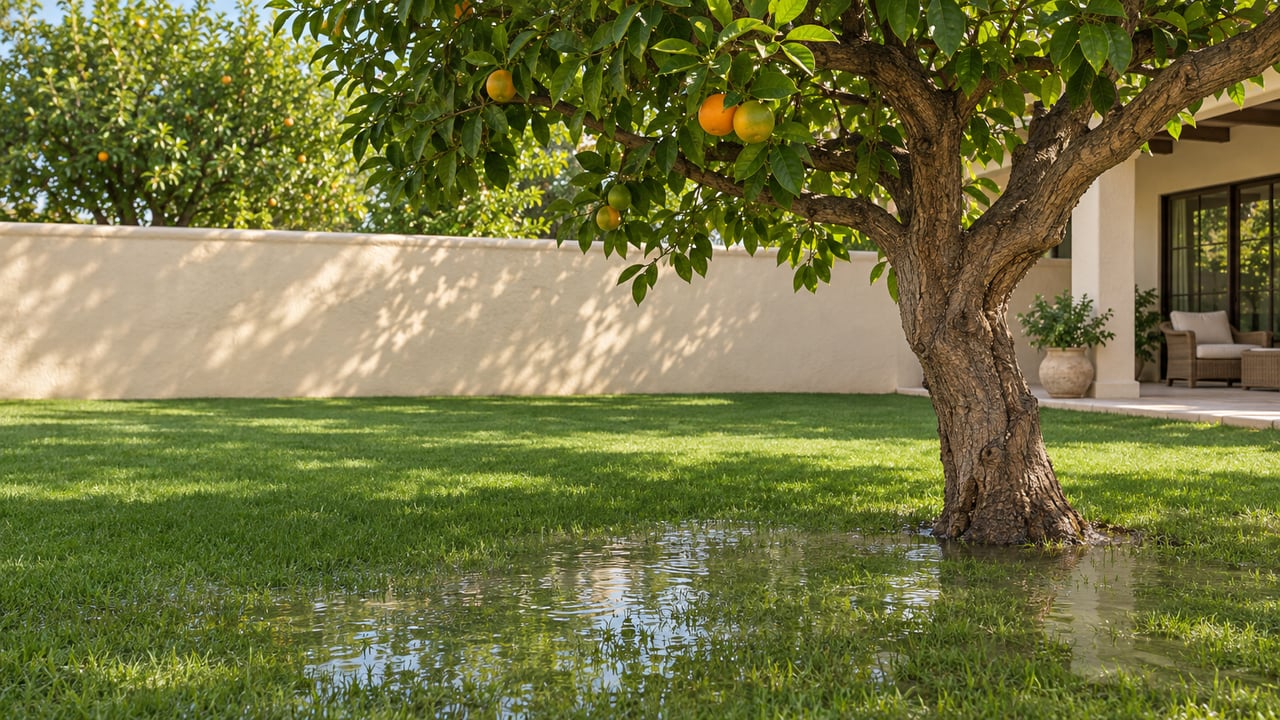
The yard has to be built for it. SRP's residential owner's manual says a flood watering typically puts 2 to 3 inches of water on the land, and it soaks in within hours. The manual recommends berms 12 to 18 inches wide that stand 3 inches above the property's maximum water level. SRP's responsibility ends at the neighborhood gate. Past that point, the private ditches, pipes, valves and berms belong to the neighbors, who also operate and maintain them. SRP advises keeping those structures clear and in repair to prevent flooding and missed deliveries.
So a buyer touring an SRP-irrigated lot should look past the lawn. Check the berm, the yard valve and the condition of the shared pipe that reaches the property line, because the owner and the neighbors keep those working.
SRP also makes the case for the trees. Its Fall 2026 newsletter says deep watering helps tree roots grow farther into the soil, and that shade trees can help lower temperatures around a home. The 1940 windbreak and the old groves grew on that kind of watering.
The Arcadia Water Company: wells, a board and its own schedule
The Arcadia Water Company does not take water from the canal system. Arcadia News described how it worked at its centennial: groundwater is pumped from five deep wells into a reservoir of about 375,000 gallons under the company's parking lot. Main lines then run along Camelback Road to 64th Street, and a lower line curves south on 64th Street to Exeter and runs west toward 44th Street. Company irrigators open and close the valve for each house. The same profile put the company's service at around 800 homes at that time.
The company's own website describes it as an Arizona nonprofit that serves its members and has an elected 11-person board. Three board seats come up each year at an April meeting. The site lists a $100 membership fee and says water, delivery service and repairs may be charged separately. Its contact page lists Shawn Hutt as operations manager, with the office at 480-945-4621 and [email protected].
Delivery works differently from SRP's ordering system. The company posts schedules by street, and its Group A schedule for the week of Nov. 9 had both daytime and evening slots, including the Nov. 9 hours on 65th Place and 66th Street. An owner on one of these lines follows the company's posted calendar and pays the company, not SRP. A buyer comparing an Arcadia Water Company lot with an SRP lot is comparing two different fee structures and two different contacts for the same green yard.
The company has also worked to keep fruit trees in the ground. In 2018 it posted a rebate of up to $200 a year for members who planted new citrus or other fruit trees. Ask the office whether the program is running now before counting on it.
What to confirm for a specific Arcadia address
No map of laterals or water-company lines settles which system serves a given house. SRP says its territory and a property's eligibility have to be confirmed by address, and that maps of private neighborhood systems can be inaccurate or out of date. For a buyer, the address check belongs next to the inspection and the appraisal on the to-do list. In practice, it comes down to a few questions:
- Which system serves this lot, SRP or the Arcadia Water Company? Confirm it by address with SRP or with the Arcadia Water Company office.
- If the lot is on SRP, what does the 2027 bill show, and has it been paid ahead of the Dec. 6 due date?
- What shape are the berms, the yard valve and the shared neighborhood pipe or ditch?
- Which nights has the neighborhood been getting water lately, and does that fit the household's schedule?
- Have the yard and trees been receiving regular deliveries, or has irrigation lapsed while the house sat empty?
The answers change how two similar listings compare. Picture two Arcadia houses with the same square footage and the same mature citrus. One owner might pay SRP once a year and have a valve to open on a rotating night. The other might hold an Arcadia Water Company membership and water by the company's posted street schedule. For a house whose value rests heavily on its yard, that difference belongs in the pricing conversation. Our guide to what an Arcadia home is really worth covers the other factors that go into that number.
Quick questions
Is every house in Arcadia on flood irrigation? No. SRP's service has to be confirmed address by address, and the Arcadia Water Company serves its own members along its lines. The system behind any one yard is a question for that address.
When does SRP flood irrigation happen in winter? SRP's residential deliveries run about every 28 days from October through March, compared with about every 14 days from April through September. Start times rotate, and many slots fall at night.
How does a new owner start SRP service? SRP's sign-up steps are to confirm the property is in SRP territory, call to set up an account, then place orders through My Account, the SRP Water app or by phone. Orders can be set to repeat.
If you're comparing Arcadia homes, or getting ready to sell one with a yard that has been watered for decades, irrigation should be one of the facts in your pricing. The Real Estate Experts of Phoenix can talk through how a yard's water source fits into an Arcadia-specific price. When you're ready, Get Your Instant Home Valuation at our home valuation page.